Where to Stay in Dublin: Best Neighbourhoods for Every Trip

Bobby Atwal — Savvy JetsetterAugust 3, 20264 min read
Where to Stay in Dublin: Best Neighbourhoods for Every Trip

Short answer: for a first trip to Dublin, stay on the Southside of the city centre — the area around Trinity College, Grafton Street and St Stephen's Green. It's central, flat, walkable and safe, and it puts Dublin Castle, Temple Bar, the museums and the best restaurants within a 15-minute stroll. If you want nightlife on your doorstep, edge toward Temple Bar; if you want quiet, head to Ballsbridge; if you want value, look at the Northside and the Docklands. Below is an honest neighbourhood-by-neighbourhood breakdown so you can match the area to the trip you're actually taking.

Dublin is smaller than most first-time visitors expect. The River Liffey splits the city into the Southside (traditionally the more polished, hotel-heavy half) and the Northside (grittier in parts, better value, and home to O'Connell Street and the Docklands). Almost everything a visitor wants sits within about a 25-minute walk of the river, so "where to stay" is really a question of atmosphere and price, not distance.

Southside city centre (Grafton Street, St Stephen's Green, Trinity) — best for first-timers

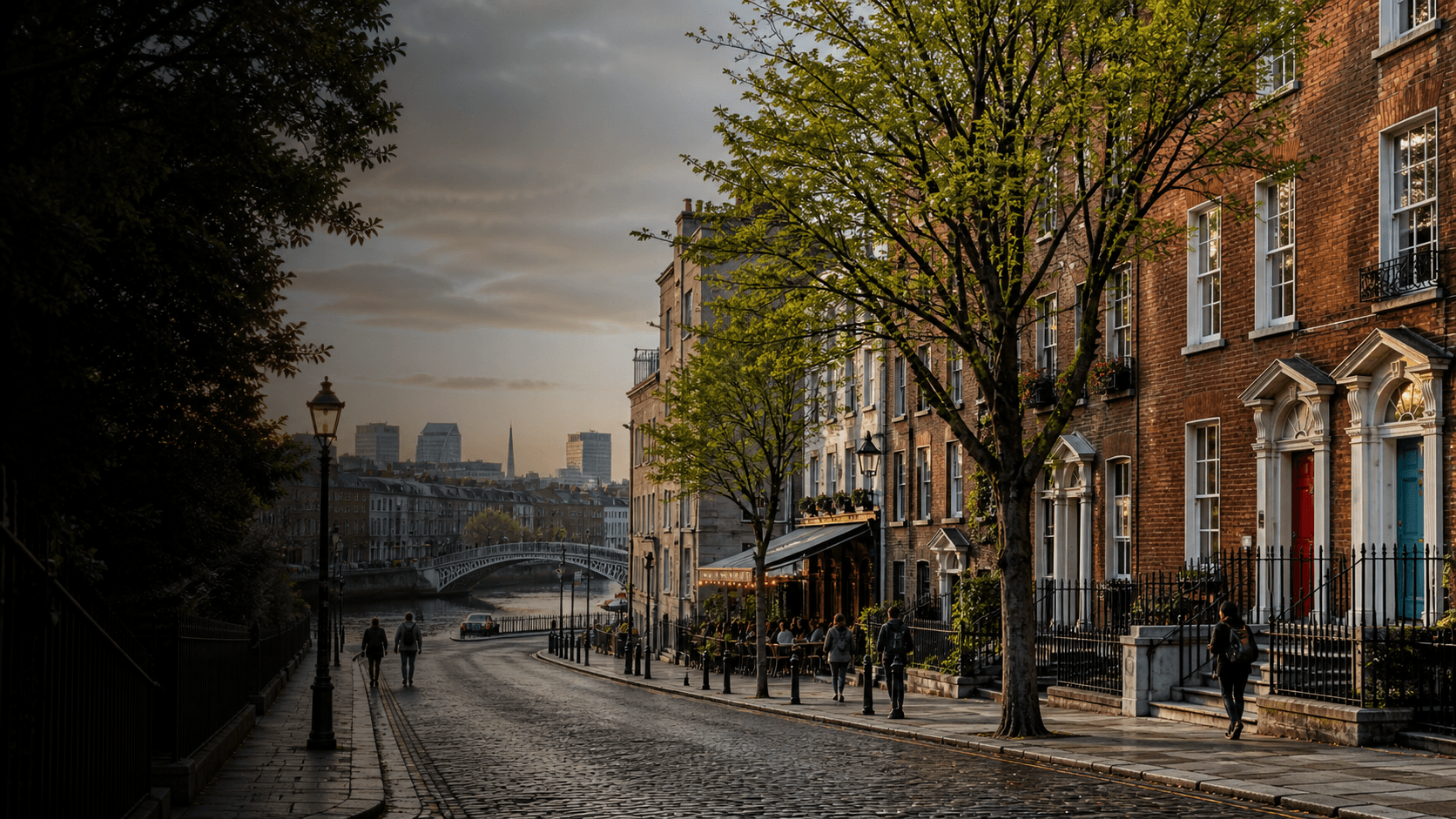
This is the postcard Dublin: Georgian doorways, the shopping on Grafton Street, the green expanse of St Stephen's Green, and Trinity College with the Book of Kells. It's the most central place to stay and the easiest to navigate on foot, which is why it's the default recommendation for a first visit.

It's also where Dublin's grandest addresses sit — the kind of hotels people mean when they say "a proper Dublin hotel," clustered around the Green and Merrion Square. Expect the highest room rates in the city here, especially in summer and during rugby weekends. If your priority is walking everywhere, feeling safe late at night, and being minutes from the main sights, this is the area to book — and the one where an advisor's hotel perks tend to be most worthwhile, because the properties are exactly the four- and five-star hotels that offer them.

Stay here if: it's your first time, you want to walk to everything, and you don't mind paying a premium for location.

Temple Bar — best for nightlife, worst for sleep

Temple Bar is the cobblestoned quarter between the Southside centre and the river, and it's the beating heart of Dublin's pub scene. Staying inside it means live music and crowds are literally outside your window — which is the appeal and the problem. Rooms here command a premium and the noise runs late, every night, not just weekends.

The savvy move is to stay near Temple Bar rather than in it: a few streets south toward Dame Street or east toward Trinity, you'll be a five-minute walk from the pubs but able to actually sleep.

Stay here if: nightlife is the entire point and you're only in town a night or two. Otherwise, stay close and walk in.

The Northside (O'Connell Street & around) — best for value

Across the Liffey, the Northside around O'Connell Street is more workaday, but it's convenient — close to the main shopping on Henry Street, the LUAS tram, and Connolly and the airport bus — and consistently better value than the Southside for a comparable standard of hotel. It has shaken off a lot of its old reputation; the main streets are busy and well-lit.

Stay here if: you want a central-enough base at a lower nightly rate and you're comfortable with a more mixed, less polished neighbourhood.

The Docklands (Silicon Docks) — best for modern hotels and quiet nights

East of the centre along the river, the Docklands is Dublin's newest quarter: glass office towers, the Bord Gáis Energy Theatre, and a cluster of modern, business-grade hotels. It's calm in the evenings, walkable to the centre in 15–20 minutes, and well served by the LUAS. Rooms tend to be newer and larger than the period buildings in the old centre.

Stay here if: you prefer a contemporary hotel, value a quiet night, and don't mind a short walk or tram into the historic core.

Ballsbridge & Donnybrook — best for families and a calmer stay

South-east of the centre, Ballsbridge and Donnybrook are leafy, embassy-lined and residential, with some of the city's larger hotels and easy DART and bus links into town (about 10–15 minutes). This is where to base a family or anyone who wants a quieter, more spacious stay without giving up access to the centre.

Stay here if: you're travelling with kids, want more room for your money, and don't need to roll out of bed onto Grafton Street.

How to choose, in one line

  • First time, want to walk everywhere: Southside city centre (Grafton Street / St Stephen's Green).
  • Nightlife first: near Temple Bar (not in it).
  • Best value, still central: the Northside around O'Connell Street.
  • Modern hotel, quiet evenings: the Docklands.
  • Families or a calmer base: Ballsbridge / Donnybrook.

Whichever area you choose, Dublin's centre is compact enough that you won't need a car — and the airport is a direct bus into town. For what to actually do once you've picked a base, see our first-timer's 5-day Dublin itinerary and the full Dublin city guide.

Booking the hotel: the part most people leave on the table

Here's the thing almost no one tells first-time visitors: booking a Dublin hotel through a travel advisor costs you nothing extra. You pay the same rate you'd pay booking direct — the hotel pays the advisor's commission, not you. What changes is what comes with the room: at many four- and five-star Dublin properties, booking through an advisor adds perks like daily breakfast, a room upgrade at check-in, or a hotel credit, where the property offers them.

That's exactly what I do as a certified Fora travel advisor. Tell me your dates, your budget and which of the areas above fits your trip, and I'll match you to the right hotel — at the same price you'd find yourself, with the perks added where they're available.

Get help choosing and booking your Dublin hotel → savvyjetsetter.ca/inquiry

Frequently asked questions

Where should I stay in Dublin for the first time?
For a first visit, stay on the Southside of the city centre — the area bounded roughly by Trinity College, Grafton Street and St Stephen's Green. It's central, flat, safe and walkable, and it puts almost every major sight within 15 minutes on foot.
Is Temple Bar a good area to stay in Dublin?
Temple Bar is as central as it gets and it's the heart of the nightlife, but it's also the noisiest and most expensive part of the city, and the streets stay loud well past midnight. If pubs and live music are the whole point of your trip it's fine for a night or two; otherwise stay a few streets south or east and walk in.
What's the best area to stay in Dublin without a car?
You don't need a car in Dublin — the core is compact and walkable, and the airport is a direct bus ride. Base yourself anywhere in the Southside city centre or the Docklands and you can reach the main sights, restaurants and the LUAS tram on foot.
Which Dublin neighbourhood is best for families?
Ballsbridge and Donnybrook, just south-east of the centre, are quieter and leafier, with larger hotel rooms and easy DART/bus access into town — a calmer base for families than the city core.
Is it safe to stay on Dublin's Northside?
Yes. Around O'Connell Street and the Docklands the Northside is well-trodden, convenient and close to the tram and train lines. As in any city, use ordinary sense late at night, but there's no reason to rule the Northside out — it's often often better value than the Southside.
How many days do you need in Dublin?
Three to five days covers Dublin itself comfortably, with time for a day trip to the coast or Wicklow. See our first-timer's 5-day Dublin itinerary for a day-by-day plan.
Do I pay more to book a Dublin hotel through a travel advisor?
No — you pay the same rate you'd pay booking the hotel direct. The hotel pays the advisor's commission, not you, and many properties add perks such as breakfast, a room upgrade or a resort credit where they offer them. It costs nothing extra to book through an advisor.

Browse Travel Guides

In-depth city guides with hotel picks, food recommendations, and insider tips.

Book a Travel Adviser

Get VIP hotel perks, personalized planning, and TICO-certified expertise.