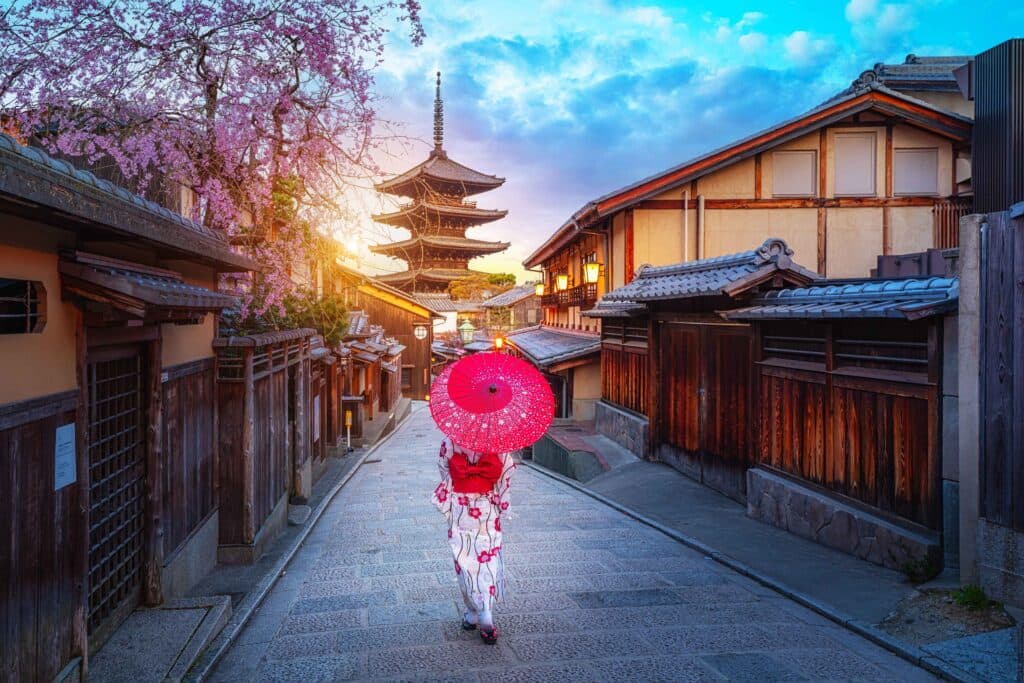
Kyoto Travel Planning & Itineraries
By Bobby Atwal, TICO-registered travel advisor (Fora Travel), Toronto · Updated
Japan's former imperial capital and the country's most concentrated dose of traditional culture. Over 1,600 Buddhist temples, 400 Shinto shrines, the world's most famous geisha district, and entire neighborhoods that haven't visually changed in 300 years. Smaller and quieter than Tokyo, Kyoto rewards travelers who slow down — it's the rare destination where the best moments happen in the early morning before the tour buses arrive.
Free advisor planning includes Fora Reserve hotel perks at no extra cost — or use our AI planner to pace your Kyoto days, pick the right neighbourhoods, and build a route that makes sense.
Kyoto at a glance
- Best time to visit
- Late October-November for autumn foliage (the famous moss gardens turn red and gold) or late March-early April for cherry blossoms — both spectacular but heavily crowded.
- How long to stay
- Three to four days minimum. Five if you want to add Nara, Osaka, or Uji as day trips. Two days only allows the absolute famous spots and you'll be exhausted.
- Budget
- $70-120 USD/day (guesthouse or business hotel, teishoku set lunches at Y800-1,500, buses + walking).
- Getting there from Canada
- Fly into Kansai International (KIX) near Osaka. From KIX, the JR Haruka Express runs direct to Kyoto Station in 75 minutes (~Y3,600).
Planning Your Kyoto Trip
Best Time to Visit
Late October-November for autumn foliage (the famous moss gardens turn red and gold) or late March-early April for cherry blossoms — both spectacular but heavily crowded. May and early-to-mid June are quieter alternatives with great weather. Avoid the brutal humidity of July-August. Winter (December-February) is cold but stunning with rare snow on the temple roofs and almost no crowds.
Budget Overview
Budget: $70-120 USD/day (guesthouse or business hotel, teishoku set lunches at Y800-1,500, buses + walking). Mid-range: $200-350 USD/day (boutique ryokan or 4-star hotel, kaiseki lunch, temple admissions, geisha district walking tour). Luxury: $700+ USD/day (top-tier ryokan with private onsen and multi-course kaiseki dinner, Aman Kyoto, private guide). Ryokan stays are where Kyoto gets expensive and where the magic happens.
Getting There
Fly into Kansai International (KIX) near Osaka. From KIX, the JR Haruka Express runs direct to Kyoto Station in 75 minutes (~Y3,600). From Tokyo, the Tokaido Shinkansen bullet train gets you to Kyoto in 2 hours 15 min on the Nozomi (Y14,170) or 2 hours 40 min on the Hikari (covered by JR Pass).
Getting Around
Buses + walking + bikes — Kyoto is flat and compact. The city bus is the main transit (Y230 flat fare; 1-day pass Y700). A bike rental is magical for temples in the east (Higashiyama) or the Philosophers Path. Taxis are reasonable for temple-to-temple hops. The JR and Keihan lines reach Arashiyama and Fushimi Inari quickly.
Common Kyoto planning mistakes
Visiting Fushimi Inari mid-day
The red torii gates are packed with tour groups 10am-3pm. Arrive at 7am or go after 5pm — its open 24 hours and magical at dusk.
Treating Kyoto as a day trip
3-5 days is the minimum. Temples, gardens, tea ceremony, geisha district, Arashiyama bamboo grove — none of it rushes well.
Trying to walk between all major temples
Kinkaku-ji is far north, Fushimi Inari far south, Arashiyama west. Plan geographic days — dont zigzag.
Photographing geisha in Gion
Hanamikoji Street has a photography ban with fines up to Y10,000. Real geiko/maiko are working — not a free tourist attraction.
Kyoto Neighbourhoods
Higashiyama
The historic eastern district. Wooden teahouses, traditional ryokan, and walking distance to Kiyomizu-dera, Yasaka Shrine, and Gion. Most atmospheric area to stay. — best for: first-timers, photographers, traditional Japan immersion
Gion
The famous geisha district. Wooden teahouses, paper lanterns, and the city's most photographed street (Hanamikoji). Stay overnight to experience it without daytime crowds. — best for: cultural seekers, ryokan stays, evening atmosphere
Downtown Kyoto (Kawaramachi/Pontocho)
The modern center with restaurants, shopping, and the river. Best base for travelers who want walkability and dining variety over traditional aesthetics. — best for: foodies, walkability, modern conveniences
Arashiyama
The famous bamboo grove and surrounding temple district 30 minutes west of central Kyoto. Stunning at sunrise, mobbed by 10am. — best for: day trips, not as a base
Northern Higashiyama (Ginkaku-ji area)
Quieter than southern Higashiyama. The Philosopher's Path, Ginkaku-ji (the Silver Pavilion), and Nanzen-ji temple complex. More residential. — best for: slow travelers, repeat visitors
Fushimi (south)
Home to the iconic Fushimi Inari shrine with thousands of red torii gates. Best visited at 6-7am before crowds arrive. — best for: day trips, photographers
Kyoto Food & Drink
Kikunoi
Yoshihiro Murata is the godfather of modern kaiseki. Lunch tasting from Y15,000.
Nishiki Market
The 400-year-old kitchen of Kyoto. Pickles, tofu, wagashi sweets, yuba, and maccha soft-serve.
Ippudo Kyoto Nishiki
Original of the now-global Hakata tonkotsu chain. Y900 bowl, 20-minute queue.
Giro Giro Hitoshina
Young chef doing innovative kaiseki at a fraction of traditional prices. Book 2 weeks ahead. Y7,000-10,000.
Nishiya
Gion. 12-seat counter. 2 Michelin. Tempura course at Y12,000.
Tsujiri Gion
Uji green tea shop with matcha parfaits and soft-serve. A Gion ritual after temple-hopping.
Pontocho Alley izakayas
Between Sanjo and Shijo bridges. 100+ tiny restaurants and yakitori bars. Walk slowly, pick based on vibe.
Day Trips from Kyoto
Nara
45 min by JRGreat Buddha at Todai-ji, 1,200 bowing deer in Nara Park, Kasuga Taisha shrines lanterns. 45 min by train.
Osaka (food day)
30 min by JRDotonbori neon, takoyaki, okonomiyaki, kushikatsu, and Osaka Castle. 30 min by JR from Kyoto. Do a night food crawl.
Uji
30 min by JRMatcha capital of Japan. Byodo-in Temple (on the Y10 coin), riverside tea houses. Half-day trip.
Hiroshima + Miyajima
2 hr by ShinkansenPeace Memorial, A-Bomb Dome, floating torii on Miyajima Island. 2 hours by Shinkansen. A full, heavy day.
Ready to build your Kyoto days?
Tell us your dates, pace, and interests — we’ll draft a day-by-day Kyoto itinerary in under a minute.
A Sample Kyoto Itinerary
Here’s a flavour of what our AI planner builds. Generate your own personalized Kyoto itinerary in 60 seconds — free.
Arrive + Eastern Higashiyama
- •Arrive via Shinkansen from Tokyo
- •Kiyomizu-dera Temple + Sannenzaka slope
- •Gion stroll at dusk
- •Dinner in Pontocho Alley
Golden Pavilion + Arashiyama
- •Kinkaku-ji (Golden Pavilion) at opening
- •Ryoan-ji rock garden
- •Arashiyama bamboo grove + Iwatayama monkey park
- •Kaiseki dinner at Kikunoi
Fushimi Inari + Tea
- •Fushimi Inari at 7am (beat the crowds)
- •Tofuku-ji garden
- •Tea ceremony in Nishijin
- •Evening izakaya crawl in Gion
Nara day trip
- •JR to Nara
- •Todai-ji Great Buddha
- •Nara Park deer + Kasuga Taisha
- •Return to Kyoto for matcha sweets at Tsujiri
Nishiki + departure
- •Nishiki Market breakfast crawl
- •Nijo Castle
- •Last-minute Kyoto crafts shopping
- •Shinkansen departure
Kyoto Travel FAQ
How many days do I need in Kyoto?
Three to four days minimum. Five if you want to add Nara, Osaka, or Uji as day trips. Two days only allows the absolute famous spots and you'll be exhausted. Kyoto rewards travelers who let themselves wander — give yourself at least one unscheduled half-day.
How do I avoid the crowds?
Be at the famous temples by 6:30-7:00am. Fushimi Inari, Arashiyama Bamboo Grove, and Kiyomizu-dera all transform when you arrive at sunrise vs midday. Late afternoon (4-5pm) is the second-best window. Daytime in spring and autumn at popular spots is genuinely shoulder-to-shoulder.
Should I stay in a ryokan?
Yes, at least one night. A traditional ryokan with tatami mats, futon bedding, kaiseki dinner, and an onsen bath is a core Japan experience that you can't replicate in a hotel. Even mid-range ryokan ($200-300/night) deliver something special. Splurge on one night, then return to a modern hotel for the rest if you prefer beds.
Is Kyoto walkable?
Mostly. The historic eastern districts (Higashiyama, Gion) are walkable end-to-end. The wider city is too spread out — you'll need the bus system, taxis, or bicycle rentals. Renting a bike is genuinely the best way to see Kyoto if the weather cooperates.
Should I combine Kyoto with Tokyo?
Almost always yes for first-timers. The shinkansen (bullet train) takes 2 hours 15 minutes between them and the JR Pass makes it nearly free if you have one. Three days each, plus an Osaka day trip from Kyoto, makes a perfect 7-day Japan itinerary.
Explore More Destinations
Want Kyoto planned for you?
Your Savvy Jetsetter advisor personally plans Kyoto trips with handpicked hotels, Fora Reserve perks, restaurant bookings, and end-to-end support. Hotel bookings are complimentary; the hotel pays the commission.