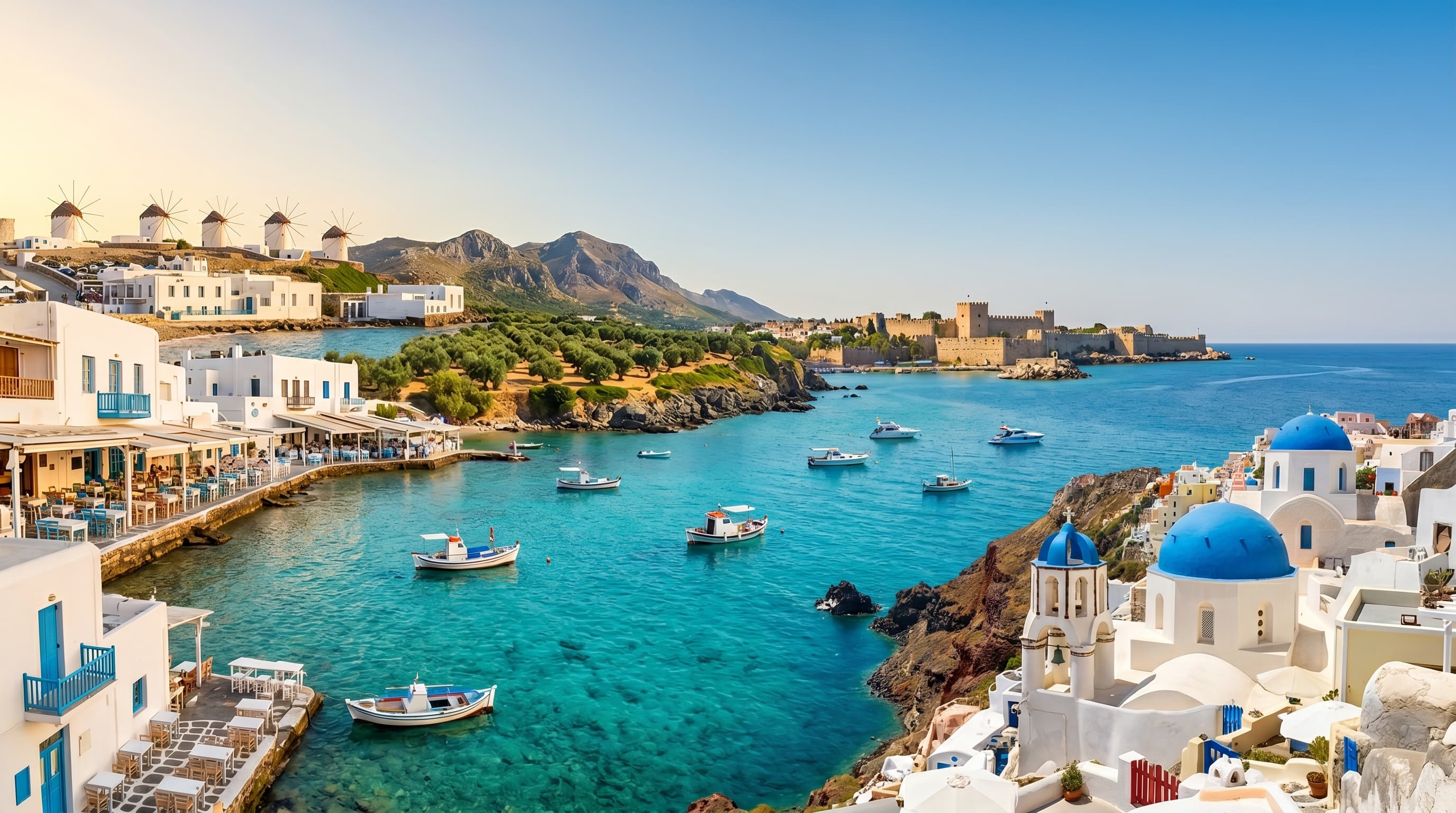
Ten days in Greece and a screen full of options. Santorini is the obvious one. It's been in every travel feed you've ever scrolled. Then there's Mykonos (expensive, everyone says), Crete (huge, apparently needs a full week), Rhodes (less talked about, lower profile), and at least six more islands you half-researched at midnight before closing the tab. The booking screen stays open. You close the laptop. You open it again.
Here's what this guide is actually trying to do: not tell you where is most beautiful, but help you figure out which island fits how you travel. The Greek islands reward independent travel more than almost anywhere in Europe, but only once you stop trying to see all of them and commit to a decision.
So let's sort it out.
The big four: which Greek island is best for first-timers
Picking the best Greek island for a first trip isn't about picking the most famous one. It's about matching the island to how you actually want to spend your time. Here's the honest case for each of the big four. Real neighborhoods, real restaurants, real price expectations.
Santorini
Best for: couples, bucket-list photography, once-in-a-lifetime trips
Santorini earns the hype and also delivers exactly the crowds you've heard about. The caldera views from Oia, with white-washed walls dropping into a volcanic crater above a deep-blue sea, are spectacular in a way photos don't capture. That's genuinely true. It's equally true that in July and August, the narrow paths are elbow-to-elbow by 4pm, a coffee with a caldera view costs $15, and the famous sunset you're picturing involves sharing it with a few thousand other people.
Two to three nights is the right allocation. Enough time to catch the Oia sunset, spend a morning in quieter Imerovigli (same caldera views, a fraction of the crowd), and eat at Metaxy Mas in Exo Gonia, a local taverna about 10 minutes inland from the main strip. The food costs a third of what the caldera spots charge and is significantly better. The Pelican in Fira works for a solid midday meal.
For accommodation, Kirini Suites runs around $140 to $180 a night for proper caldera views without the top-tier markup. If budget isn't the constraint, Canaves Oia Epitome sets the bar for private pools and quiet.
One to skip: any restaurant where the menu opens on a QR code and "caldera view" appears on the signage in four languages. They're selling the view, not the kitchen.
Mykonos
Best for: nightlife, beach clubs, LGBTQ+ travelers, people who want a high-energy social summer
Mykonos is expensive. $18 cocktails, $50 sun loungers at Paradise Beach, hotels priced like they're operating in a different currency. If that's going to frustrate you, redirect to Crete. If you're going specifically for the scene, the beach clubs at Super Paradise, the labyrinthine Chora alleyways lit up at midnight, the chaotic and genuinely fun energy of a summer where everyone is out, then it fully delivers.
The town (Chora) is beautiful before noon and after 10pm, when the day-trippers are gone. Walk it early and it feels like a different place entirely. Kiki's Tavern near Agios Sostis beach is the non-negotiable stop: cash only, no reservations, perpetual queue of people who don't care about the wait, grilled meat that makes it worth every minute. Kastro's Bar on the old harbor for sunset is the other essential.
Budget around $180 to $250 a night for a decent hotel in high season. In May or September this drops meaningfully, and the island has a different, calmer energy that some people actually prefer.
Crete
Best for: travelers who want history, beaches, and real food culture in the same trip
Crete is the best-value pick on this list, and consistently the island people underestimate. It's the largest Greek island by a significant margin, and the range is real: Minoan ruins at Knossos outside Heraklion, the photogenic lanes of Chania's Venetian harbor, Elafonisi beach on the western coast (the sand is genuinely pink, not a tourism exaggeration), and a local food culture that's distinct from the rest of Greece.
You need a rental car. That's not a maybe. Without one you'll be pinned to the main towns, and the best of Crete is in between them. Budget around $35 to $50 a day for a small car. The roads are straightforward.
For food: Peskesi in Heraklion does farm-to-table Cretan cuisine in a beautifully restored stone space. The kind of meal that makes you want to stay an extra night. To Maridaki in Chania is the fresh fish lunch you'll still be talking about two weeks after you're home.
Accommodation runs significantly cheaper than Santorini. $80 to $140 a night covers solid mid-range. White Lion Chania is a good boutique pick in the old town. For full luxury on the eastern coast, Domes of Elounda is the property.
If you have 5+ days and you're working out a Greece itinerary for the first time, seriously consider anchoring on Crete. You can build a day-by-day plan based on your interests (history, beaches, food) in 60 seconds with the build your free Greek islands itinerary tool.
Rhodes
Best for: history, families, first-timers who want sun without the Santorini price tag or the Mykonos scene
Rhodes doesn't get the same attention as the other three, which is increasingly a reason to put it on your shortlist. The UNESCO-listed medieval Old Town is one of the most intact functioning medieval cities in Europe. Cobblestone lanes, stone archways, a living neighborhood inside ancient walls. Walk it for a few hours and the difference from the curated aesthetics of Santorini becomes obvious.
Lindos village, 45 minutes south by car, is worth a full day: whitewashed lanes climbing toward an ancient acropolis above a clear bay. Rodos Park Suites in Rhodes Town gives you easy Old Town access at reasonable rates. Melenos Lindos is the distinctive pick if you want something more intimate.
Rhodes also comes in meaningfully cheaper on hotels, food, and ferries than Mykonos or high-season Santorini. A real consideration if value matters.
Island hopping in Greece: is it actually worth it?
Honest answer: one or two islands in 9 or 10 days is almost always better than three.
Island hopping is a romantic concept that works better in principle than in transit. A standard Blue Star Ferries crossing from Athens to Santorini takes 5 to 8 hours; SeaJets fast cats cut it to around 4 but cost more and run subject to sea conditions. Between the crossing, port wait, getting to your accommodation on the other end, and recovering from a night sailing, you lose a full day per hop. Three islands in ten days means you're spending a meaningful chunk of the trip in transit.
If two islands is the plan, Santorini plus Crete is a solid combination. They're different enough to feel like two distinct trips. Mykonos plus Santorini is the classic Cyclades pairing, with a shorter crossing (around 2 hours on the fast ferry). Rhodes pairs better with extended mainland time than with the western islands.
Practical ferry notes:
- Book in advance for June through September travel. Popular summer sailings fill up, especially overnight cabins. Book direct on Blue Star Ferries or SeaJets.
- Cost per leg: roughly $30 to $60 economy; fast cats run $60 to $90.
- Domestic flights: Athens to Santorini or Mykonos on Aegean Airlines or Sky Express often take 45 minutes and are worth checking if ferry timing doesn't work.
On Athens: Spend at least one night here, ideally two. The Acropolis is non-optional. Even if you've seen a thousand photos, standing in front of it delivers in a way that feels unreasonable. For eating, track down Diporto near the central market: no printed menu, no English-language anything, cash only, wine poured from barrels, daily food that changes with what the kitchen has. Lunch is the move.
For deeper destination planning (ferry routing, hotel picks, day-by-day structure), our destination guides library is a good next step.
When to go to the Greek islands
May and June is the best window for a first-time visit, no qualifications. Weather is warm (25–30°C / 77–86°F), the islands aren't yet at capacity, accommodation prices are 20 to 40% lower than peak, and you can actually walk around Oia at 4pm.
July and August is peak season. Hot, crowded, and expensive. Santorini and Mykonos in particular are genuinely hard to enjoy in those months. They're built for a summer crowd and they get it. If these are your only available months, it still works, but book everything 3 to 4 months out and adjust your price expectations.
September and October is the sleeper pick. Water temperatures are warm from a full summer of sun, September crowds thin noticeably after the first week, restaurant quality holds, and prices begin to drop. If you have flexibility, late September beats May for swimming specifically.
December to February: Most of Santorini closes outright. Some islands become near-ghost towns. Unless you're specifically going for off-season Crete or Rhodes with that particular quiet in mind, skip it.
Common mistakes first-timers make in the Greek islands
A few patterns trip people up every time, regardless of which island you pick.
Spending too many nights in Santorini. Two to three nights is right. People over-allocate here because the photos are better, then find themselves restless by night three on a small island with limited ground to cover. Two well-used nights beats four aimless ones.
Not booking ferries in advance for summer travel. For July and August departures, popular routes sell out. This isn't a theoretical risk. It happens regularly on high-demand sailings from Athens and between the Cyclades. Book as soon as your dates are confirmed.
Writing off Crete as a consolation island. Santorini vs Mykonos vs Crete isn't even a close call for travelers who want substance. Crete consistently wins for first-timers who want to eat well, see something historically significant, and feel like they've been somewhere rather than photographed it.
Skipping Athens entirely. One night minimum, and "just a layover city" undersells it. The Acropolis, Monastiraki, Diporto at lunch. Athens deserves more time than most itineraries give it.
Cramming Santorini and Mykonos into fewer than four days. Both islands need 2 to 3 nights to feel like more than a transit stop. Three days between them means you'll spend 30% in transit and feel like you saw neither properly.
Not renting a car in Crete or Rhodes. The beaches and villages you'll remember aren't near the ferry ports. In both islands, a car is the difference between the brochure version of the trip and the real one.
Plan your Greek islands trip
Greece is very plannable once you stop trying to fit every island into one trip. There isn't one right answer, and any guide that tells you otherwise is selling you something. Pick one or two islands that match how you travel, give them proper time, and the planning itself becomes straightforward.
If you want a day-by-day Greece itinerary, build your day-by-day Greece itinerary around your specific travel style: destination, dates, group size, budget, and interests. You'll have a full itinerary in 60 seconds.
For more complex routing (multiple islands, hotel introductions, VIP perks, or a trip you want handled properly from start to finish), our travel advisory service manages the logistics end to end.
The only Greek islands mistake that actually matters is not going. Pick an island, book the ferry, and work out the rest from there.