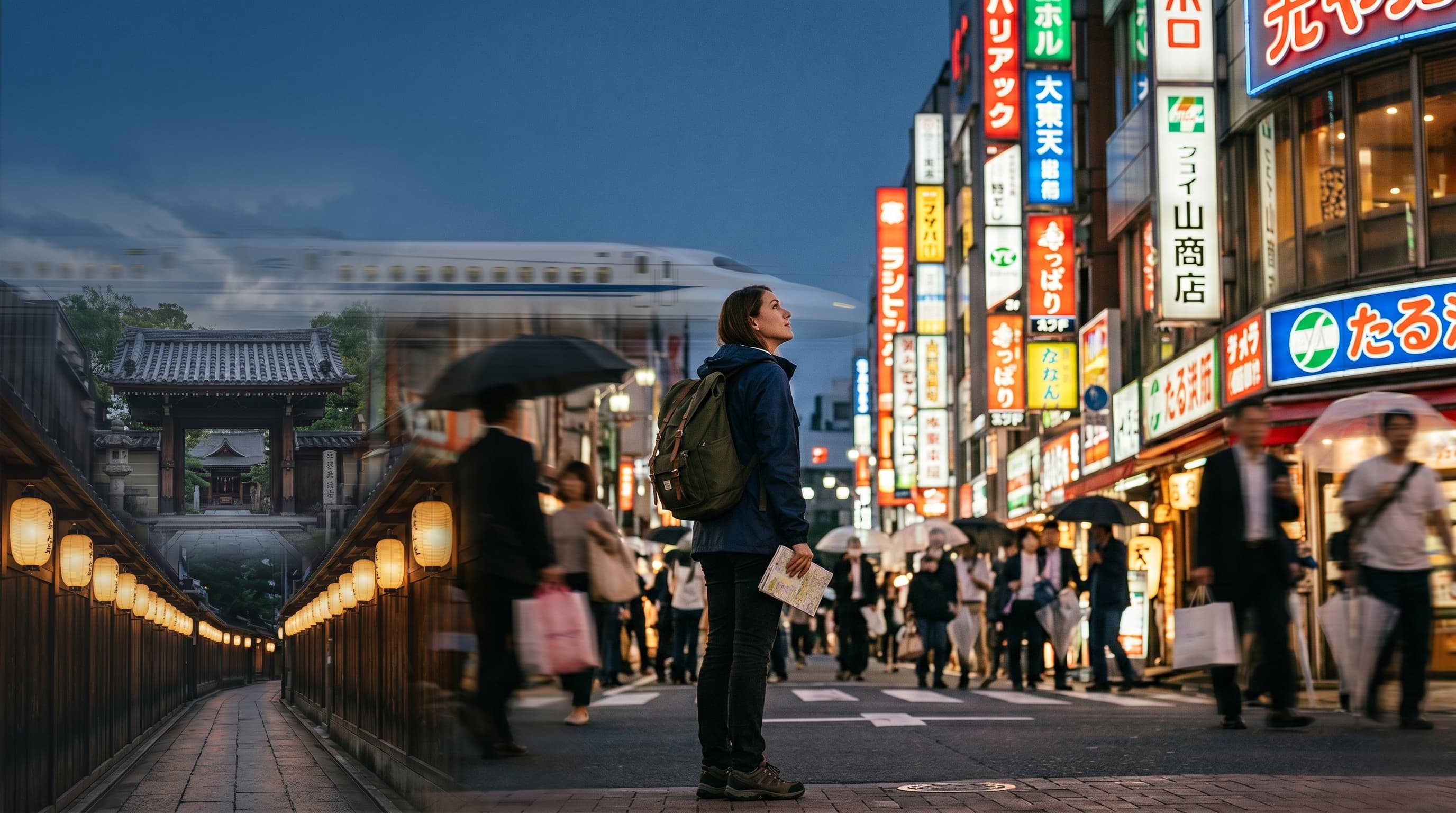
The tour company quoted $7,800 USD per person. Fifteen days across Japan, a luggage tag, and a schedule so packed that "free time" in Kyoto's Gion district was a two-hour block. Forty-five minutes once you subtract the bus from the hotel.
What if you built the same trip yourself? Same cities, same fourteen nights, planned by you. The answer, reliably, is that you'd spend about half the cost, move at your own pace, and actually remember the details when you get home.
Japan has sat at the top of most-searched long-haul destinations for the past several years, and a self-guided Japan itinerary has never been more practical. The trains are the most reliable on earth. Major stations carry English signage throughout. Once you understand the two transit tools that run the whole system, the logistics click into place quickly. Japan, in many ways, is built for people who show up having done a bit of research.
This is a self-guided Japan itinerary written for first-time visitors. Specific hotels, restaurants worth a reservation, and a day-by-day structure that gives each city the time it deserves without burning out before you reach Kyoto.
Why self-guided beats a tour group
Tour operators sell convenience, but Japan doesn't really need it the way some other countries do. The two real barriers — language and navigation — have mostly been solved. Google Maps routes transit as well as a local would. Most tourist-area restaurants carry English menus or picture menus. The trains run with a precision that makes missed connections rare.
What a guided group quietly takes from you is harder to price. The extra twenty minutes at Ichiran because the bowl was worth finishing slowly. The temple you skip for the neighbourhood you stumbled into instead. Making a reservation because you wanted to go there, not because forty-two people needed a table at the same time.
The budget case is straightforward. A well-structured guided tour of Japan rarely costs less than $6,000 to $9,000 USD per person before flights. A self-guided two-week trip at a comfortable mid-range level (quality hotels, the JR Pass, three meals a day, entry fees) typically runs $3,500 to $5,000 USD depending on timing and travel style. Cherry blossom season and Golden Week are the expensive exceptions.
If you want a starting point tailored to your exact dates and interests, build a personalised day-by-day itinerary at savvyjetsetter.ca/plan. The AI planner generates a full trip plan in under two minutes, no sign-up required.
Transport: the two things you actually need
Before anything else, the two tools that make the whole trip work:
IC Card (Suica or ICOCA): A reloadable transit card you tap in and out of every subway, bus, and train in the country. You can now add it digitally to Apple Wallet or Google Pay before you leave home, which means no queuing at a machine when you land at Narita or Haneda. Use it for everything in Tokyo, Osaka, and Kyoto. It also works at convenience stores and vending machines across the country.
JR Pass: A 14-day unlimited bullet train pass costs roughly $530 to $600 USD depending on the exchange rate and where you buy it. If your itinerary covers the Tokyo-Kyoto-Osaka-Hiroshima circuit, the pass pays for itself on the first two shinkansen legs alone. Buy it online before you fly.
One of the most overlooked Japan trip planning tips: activate your JR Pass on the day you take your first shinkansen, not the day you land. If you spend three days in Tokyo before heading south, activating at the airport wastes three days of coverage. Wait until you're ready to move.
Your Japan 2-week itinerary self-guided: day by day
Days 1-4: Tokyo
Tokyo wants four full days at minimum and rewards five. The city isn't really one place; it's a loose collection of distinct neighbourhoods, each with its own character. The approach that works is picking one area to anchor in and moving through the others systematically rather than trying to criss-cross the city every day.
Stay: Sequence Miyashita Park in Shibuya sits directly above the park and is one of the better-positioned hotels at its price point in the city. Rooms are compact and well-designed, and you're a short walk from Shibuya Crossing, Harajuku, and the back streets connecting them.
Days 1-2: Get your bearings. Cross Shibuya Crossing at night when it's genuinely spectacular. Daytime photos don't capture it. Walk north through Harajuku to Meiji Jingu in the morning, then down through Omotesando in the afternoon. The architecture along Omotesando is worth the walk before you've looked up a single building name. Eat ramen at Ichiran in Shibuya on the first night. The solo-booth format has no real equivalent anywhere else, and it's open late.
Days 3-4: Shinjuku one day, east Tokyo the other. Shinjuku means Golden Gai at night: a tightly packed network of narrow lanes and six-person bars that has been going since the 1940s, and some of the most interesting drinking in Asia. East Tokyo means Asakusa's Senso-ji early in the morning before the crowds set in, a walk through Yanaka (one of the few neighbourhoods that survived wartime bombing largely intact), and Tsukiji Outer Market for breakfast if you get there before noon.
Day 5: Hakone (Mt. Fuji view day)
Take the Romancecar train from Shinjuku Station to Hakone. The whole point here is a clear view of Fuji-san, which is weather-dependent. Schedule this mid-trip rather than on your last clear day so you have room to reschedule. The Hakone Open Air Museum is worth three hours regardless of what the weather does to the mountain. One night in Hakone-Yumoto, then shinkansen south to Kyoto the next morning.
Days 6-10: Kyoto
Five days in Kyoto lets you actually be selective. Most first-timers make the mistake of stacking eight temples into a day and finishing with photo-identical memories of gravel paths and wooden gates. Kyoto rewards people who pick fewer things and go deeper.
Stay: The Celestine Kyoto Gion is a polished, quiet hotel in the heart of Gion, Kyoto's most intact traditional district. Location matters enormously in this city. Being within walking distance of Gion Shijo, Nishiki Market, and the Higashiyama walking path saves you an hour of daily transit and keeps you closer to the city's best evening streets.
Day 6: Arrive and walk Gion after dark. Hanamikoji Street at dusk is the version of Kyoto that photographs don't quite do justice: narrow lane, wooden ochaya teahouses, lantern light. Don't photograph anyone up close without permission.
Days 7-8: Nishiki Market in the morning is one of the best things in Kyoto. It's a five-block covered arcade where vendors who have been there for decades sell pickled vegetables, grilled skewers, fresh tofu, and every variety of matcha sweet you can imagine. Fushimi Inari Taisha fills a full afternoon. The famous orange torii gates extend up a mountain, and walking the path to the summit takes about ninety minutes round trip from the base.
Day 9: Arashiyama, non-negotiable, and this is where the dawn visit matters. Arrive at the bamboo grove before 7am. By 9am it's dense with tour groups and the quiet that makes it worth visiting has evaporated. Combine it with Tenryu-ji garden and the Sagano Romantic Train if the timing works. This is one of the places first-time Japan visitors consistently underestimate.
Day 10: Day trip to Nara. It's 45 minutes by express train, the giant Buddha at Todai-ji is genuinely impressive at scale, and the deer wandering the park grounds are not a curated experience. They're simply there. Go early, leave by 2pm, and travel on to Osaka in the afternoon to start your final stretch.
Days 11-12: Hiroshima and Miyajima
Hiroshima is a half-day city used well, with Miyajima filling the rest. The Peace Memorial Museum is one of the most important museums in the world. Plan two to three hours and do not rush it. The atomic bomb dome across the river is a short walk and worth seeing in context of the museum visit.
The floating torii gate at Itsukushima Shrine on Miyajima is best seen at low tide, when you can walk out to it. Tide schedules are publicly available online; check before you book the ferry. The island is worth an overnight if you want it largely empty. The day-tripper ferry traffic clears by early evening and the shrine takes on a different quality after that.
The shinkansen from Osaka to Hiroshima is under an hour.
Days 13-14: Osaka
Osaka is where you eat. The food culture here is genuinely different from Kyoto's: louder, fried, unapologetic. Dotonbori is the visual centrepiece, with the canal, the Glico running man sign, and the takoyaki stalls with permanent queues. The better meals are in the backstreets of Namba and Shinsaibashi.
Kuromon Ichiba market skews toward fresh seafood where Nishiki Market in Kyoto skews toward preserved and fermented. Worth visiting both to feel the difference. Two full days in Osaka is the right amount. If you're flying home from Kansai Airport, you're already there. If you're flying out of Tokyo, the shinkansen north takes around three hours and can be done on the morning of your departure day.
Where to stay: the short version
The two hotels named in this self-guided Japan itinerary, Sequence Miyashita Park in Tokyo and The Celestine Kyoto Gion, earn their place because of location, not luxury. Japan's mid-range tier means compact, well-designed rooms with a level of service most other countries charge significantly more to access.
If you want hotel introductions with VIP perks and room upgrades included, the travel advisory service at savvyjetsetter.ca/inquiry accesses those through Fora's hotel partner network. For deeper independent research before you book, the destination guides at savvyjetsetter.ca/guides cover accommodation picks in detail by neighbourhood.
Common mistakes on a self-guided Japan trip
Underestimating temple fatigue. Japan has over 80,000 temples and shrines. By day four in Kyoto, without some curation, they start to blur into each other. Be intentional. Three or four temples that are actually different from one another beats eight that were all on someone else's list. Ryoan-ji for the rock garden, Fushimi Inari for the torii mountain, Tenryu-ji for the combination of garden and forested backdrop. Let the rest go.
Arriving at Arashiyama after 8am. The bamboo grove is impressive, and it's overrun by mid-morning. If the transit logistics aren't working, take a taxi. It's worth the cost to experience the grove at the hour it actually delivers on its reputation.
Skipping the IC card. Some people arrive planning to buy individual transit tickets at each station because it seems more straightforward. The IC card is faster, eliminates the mental load of every single transit leg, and works at convenience stores on top of it. Get one at Narita or Haneda and load it immediately.
Over-scheduling Tokyo. The instinct is to cram every day trip in: Nikko, Kamakura, Hakone, plus six museums and four markets. Pick one day trip from Tokyo. The city itself is the itinerary for four days.
Activating the JR Pass on arrival day. If you land on a Tuesday and your first shinkansen is Friday, do not activate at the airport. You'll burn three days of a 14-day pass on Tokyo subway rides better covered by your IC card. Activate the day you board your first bullet train.
Now build your own version
Knowing how to travel Japan independently is mostly a matter of having the transport tools and a framework to work from. The Tokyo-Kyoto-Hiroshima-Osaka circuit is the classic route for a reason: it covers the range of what Japan does distinctively well, and you can pull it off without a tour company.
The proportions are adjustable. More time in Kyoto and less in Tokyo suits anyone drawn to traditional culture over city energy. Adding Kanazawa between Kyoto and Osaka rewards travellers who want fewer tourists and one of the best-preserved samurai districts in the country.
For a self-guided Japan itinerary built around your specific dates, group size, and travel interests, generate a free custom day-by-day plan at savvyjetsetter.ca/plan. No account required to see the result.
Japan rewards people who arrive having thought about it. You don't need a tour group. You just need a plan that fits the trip you actually want to take.