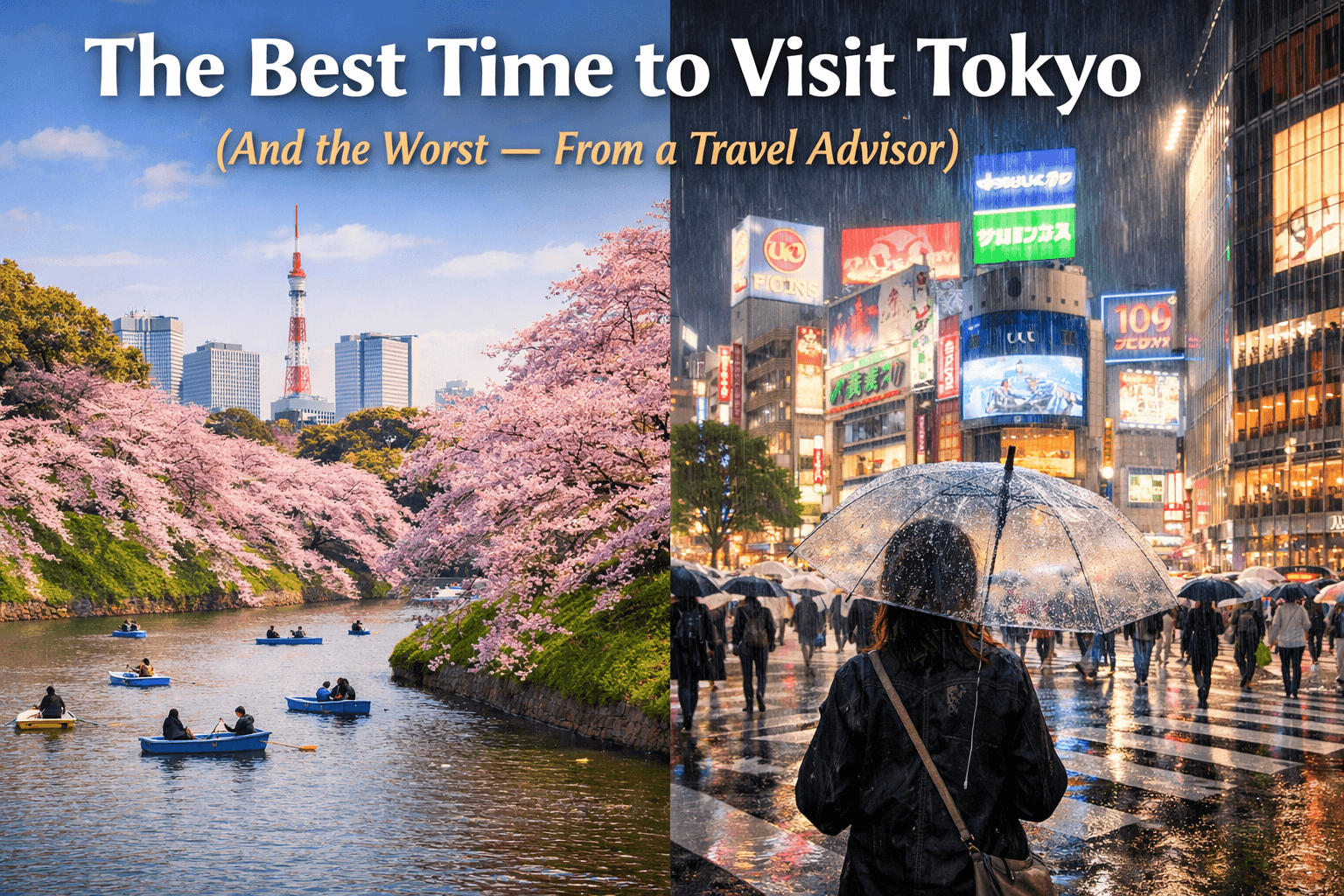
Most articles about visiting Tokyo will tell you the same thing: "Spring for cherry blossoms, fall for foliage." Then they'll list the months and call it a day.
That advice isn't wrong. It's just lazy. It glosses over the fact that "cherry blossom season" is really a 10-day window that books up six months ahead, costs 40% more than other months, and puts you elbow-to-elbow with every Instagram tourist on the planet at Meguro River. It also skips the months that are actually the best value-for-experience for most travelers.
Here's the breakdown I give my Fora clients when they ask when to go. It's based on the boring stuff travel guides skip: actual weather data, crowd patterns, hotel pricing, and what's open or closed.
January: cold, quiet, and genuinely underrated
Average temp: 2-10°C (36-50°F) Crowds: Very low Hotel prices: Low Verdict: Underrated for budget travelers and Japan repeat visitors
January is the cheapest month to visit Tokyo, and it's not even close. After New Year's (the first 3-4 days are a national holiday and surprisingly busy), the city empties out. Hotels drop to their lowest prices of the year. Restaurants that normally need a month of lead time can be booked the same day.
The catch: it's cold. Not Toronto cold or Chicago cold, but cold enough that you'll want a real jacket. Tokyo doesn't get much snow at sea level, but the wind off the bay is sharper than the temperature suggests.
The win: clear blue-sky days are common in January, and Mount Fuji is most visible during winter (warm air carries moisture that hides it the rest of the year). If you've never seen Fuji-san from a Tokyo skyscraper, January gives you the highest odds.
February: plum blossoms, better pricing than March
Average temp: 3-11°C (37-52°F) Crowds: Low Hotel prices: Low to moderate Verdict: A smart alternative to cherry blossom season
If you want flowers without the cherry blossom chaos, plum blossoms ("ume") bloom in February at gardens like Yushima Tenmangu and Hanegi Park. They're less famous than sakura, which means you can actually photograph them without tourists in the background.
Pricing is still in the off-season tier. Cold but manageable. This is the smart traveler's window if you want springlike imagery without the springtime markup.
March: the cherry blossom lottery
Average temp: 6-14°C (43-57°F) Crowds: Moderate building to high Hotel prices: Climbing fast Verdict: Worth it ONLY if you can be flexible with dates
Here's the truth about cherry blossom season: peak bloom in Tokyo is typically March 25 to April 5. That's a 10-day window that varies by 1-2 weeks every year depending on weather. You don't know the exact dates until about 3 weeks before bloom, which is after most international flights have already been booked.
So when travelers book "for cherry blossom season" 6 months out, they're gambling. Some years the bloom is early and you arrive during full peak. Other years it's late and you see bare branches.
If you can be flexible (i.e. you can move your dates by a week within the season), March is a great time to be in the city. If you're locked into specific dates, you're better off picking another month and booking with confidence.
Hotels in March cost 30-50% more than off-season. Famous viewing spots (Meguro River, Ueno Park, Chidorigafuchi) are genuinely overcrowded. Your favorite restaurants will be impossible to book without weeks of notice.
April: the tail of sakura, and then calm
Average temp: 11-19°C (52-66°F) Crowds: High first half, dropping fast Hotel prices: High first half, dropping Verdict: Mid-to-late April is the sleeper pick
By April 10, peak bloom is over and most of the cherry blossom tourists have gone home. The weather is genuinely lovely. Not too hot, not too cold, low humidity, blue skies. Late-blooming cherry varieties are still flowering at parks like Shinjuku Gyoen, so you can still get the photos without the crowds.
This is one of my favorite recommendation windows for first-time visitors who don't care about the exact sakura peak. You get 90% of the experience for 60% of the price and 30% of the crowds.
May: best all-around month
Average temp: 15-23°C (59-73°F) Crowds: Low to moderate Hotel prices: Moderate (avoid Golden Week) Verdict: The single best month for first-time Tokyo visitors
If I could only recommend one month for first-time visitors to Tokyo, it would be May. The weather is just about perfect: warm enough for outdoor everything, dry enough that you don't sweat through your shirts, cool enough that walking 15,000 steps a day doesn't destroy you. The cherry blossom crowds are gone. Rainy season hasn't started.
The one warning: avoid Golden Week (April 29 to May 5). This is Japan's biggest domestic holiday and the entire country travels. Hotels are full, trains are packed, prices spike. If you must come during Golden Week, book six months in advance.
After May 6, the country exhales. Mid-to-late May is the sweet spot of sweet spots.
June: the rainy season trap
Average temp: 19-25°C (66-77°F) Crowds: Low Hotel prices: Low Verdict: Cheap for a reason
June starts Japan's rainy season ("tsuyu") and the rain is real. Not the occasional shower. Sustained, multi-day rain that ruins outdoor plans. Humidity climbs into the uncomfortable range.
The upside: hotels are cheap, attractions are empty, hydrangeas bloom across the city. If you don't mind getting wet and you have a museum-heavy itinerary, June can work. If you came to walk Tokyo's neighborhoods and eat in parks, pick a different month.
July: hot, humid, and festival-heavy
Average temp: 23-30°C (73-86°F) Crowds: Moderate Hotel prices: Moderate to high Verdict: Only if you specifically want festivals
July is Tokyo's hottest, most humid month, and the heat is the kind that drains you within an hour of being outside. Air conditioning everywhere helps, but moving between locations is brutal.
The reason to come anyway: festival season. Sumida River Fireworks, Mitama Matsuri, and dozens of neighborhood matsuri make July a culturally rich month. If you want the "real Japan" feeling and you tolerate heat well, this can be a memorable trip.
If you wilt in heat, skip it.
August: avoid unless you have no choice
Average temp: 25-31°C (77-88°F) Crowds: High (peak Western tourist season) Hotel prices: High Verdict: The worst month for most travelers
August is when most North American and European travelers can take vacation, so they all come at once, pushing prices up and crowds higher. Combined with the brutal heat and humidity, it's the least pleasant month to actually walk around Tokyo. Many small restaurants and shops close for "Obon" (mid-August) when locals visit family.
If your only available window is August, you'll still have a good trip. Tokyo is too good to ruin entirely. But you're paying premium prices for the worst weather.
September: the best-kept secret
Average temp: 21-28°C (70-82°F) Crowds: Low Hotel prices: Moderate Verdict: Tied with May for best overall month
Late September is the quiet sister of mid-May. The summer heat finally breaks, the crowds thin out, and prices haven't yet climbed for autumn foliage season. Typhoon risk exists (especially early September), but typhoons are forecastable and rarely catastrophic.
This is the month I recommend to travelers who want autumn weather without the autumn pricing.
October: foliage build-up, beautiful weather
Average temp: 16-22°C (61-72°F) Crowds: Moderate Hotel prices: Moderate to high Verdict: Excellent for first-time visitors
Tokyo's autumn foliage peaks in late November, but October is when the weather is genuinely perfect. Cool, clear, dry, low humidity. It's the most consistently pleasant month of the year, weather-wise. Hotels are climbing toward the autumn peak but haven't fully spiked yet.
Highly recommended.
November: peak foliage, peak prices
Average temp: 11-17°C (52-63°F) Crowds: High Hotel prices: High (second peak after sakura) Verdict: Worth it for the colors, but plan early
If you want red and gold maples in Japanese gardens, November is your month. Rikugien, Shinjuku Gyoen, and the area around Mount Takao are spectacular in mid-to-late November.
Like cherry blossom season, the catch is that "peak foliage" varies by 1-2 weeks every year, and hotels book up months in advance. Pricing is at the second-highest tier of the year.
December: quiet, cold, underrated for nightscapes
Average temp: 5-12°C (41-54°F) Crowds: Low (until Christmas week) Hotel prices: Low to moderate Verdict: Underrated for shopping and city lights
December is one of my favorite stealth months. The weather is cold but clear, the crowds stay minimal until the very end of the month, and Tokyo's winter illuminations (Tokyo Midtown, Roppongi Hills, Marunouchi) are world-class. Christmas isn't a major holiday in Japan, so most things stay open.
The last week of December gets busy with Japanese travelers heading home for New Year's, so hotels spike. Before December 28, it's a quiet, beautiful, very photographable city.
My honest top 3
If I had to rank the months for the typical first-time Tokyo visitor:
- Mid-to-late May: Perfect weather, manageable crowds, no major holidays
- Late September: Same as May but with warmer evenings and cheaper hotels
- Mid-October: Most consistently pleasant weather, dry and cool
If you want the iconic experiences (sakura, foliage), accept the trade-offs and book early. If you want the best value-to-experience ratio, the months above are where I send my own friends.
When you're ready to plan, Savvy Jetsetter's free Tokyo itinerary builder will generate a day-by-day plan tailored to your travel dates, including which neighborhoods are best to stay in, how many days you actually need, and what's worth skipping. The premium upgrade ($15) adds a visa guide, hotel recommendations across price points, restaurant picks, and a tailored packing list.
Or if your Tokyo trip is part of a bigger Japan itinerary and you want a human in the loop, book a free 30-minute consultation and I'll help you map it out personally.
Bobby Atwal is the founder of Savvy Jetsetter and a certified travel advisor with Fora Travel.