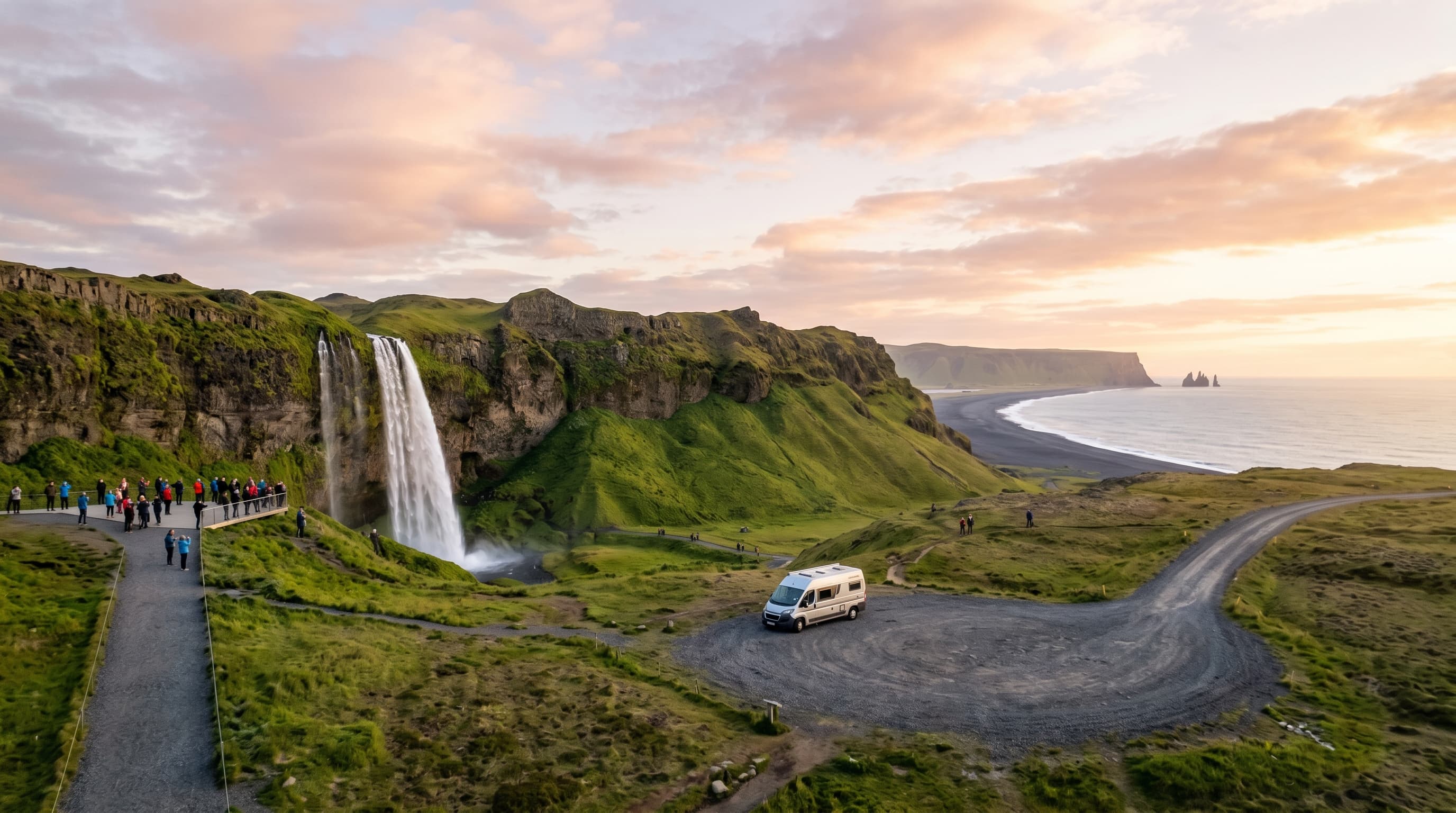
At 11pm on the Ring Road in July, the sun is still 30 degrees above the horizon. The light does something alien and golden to a landscape that already looks fabricated. You pull over at a random viewpoint, and there is no one else there.
This Iceland summer travel guide starts there, with that moment. It also starts with the 40 rental cars parked at Seljalandsfoss an hour later.
Both things are true about Iceland in summer. The landscape lives up to every photo. It is also shared, in June and July, with more tourists than most people expect. The difference between a memorable trip and an expensive lap of other people's photos depends almost entirely on how you plan around the second part.
This Iceland summer travel guide covers what actually delivers versus what does not — and the planning decisions that determine which version you get.
Iceland Summer vs. Winter: The Real Comparison
Every first-timer asks this. Here is the direct answer.
Summer gives you: The midnight sun at full strength from May through late July. F-roads open into the interior highlands from late June onward. Puffins from June through August. The full Ring Road accessible without ice driving. Landscapes that shift from stark winter white to green and dramatic.
Winter gives you: A realistic shot at the Northern Lights depending on clear skies and solar activity. Accommodation 30 to 40 percent cheaper than summer rates. Fewer tourists, particularly on the south coast. About five hours of daylight in December.
The honest answer on Iceland summer vs winter: if seeing Northern Lights is your primary reason for going, summer is the wrong choice. The midnight sun removes the darkness auroras need. Do not book June expecting them.
If you want to drive freely, hike, and access the highlands without weather restrictions, Iceland in summer is worth it. Late August through September sits in a genuine sweet spot: the midnight sun fades, prices begin to drop, Northern Lights become possible again, and the roads are quieter. If you only have one shot at Iceland, that window does a lot of things at once.
What to Do in Iceland in Summer: What's Actually Worth It
The Ring Road
Worth it. At 1,332km looping the entire island, a complete Iceland summer itinerary around the Ring Road takes 7 days if you move fast and 10 days if you actually want to stop. The difference matters in practice: 7 days is constant movement, 10 is a trip where you remember what you saw.
Where it earns its reputation: Eastern Iceland and the Westfjords. These sections have the fewest tourists and the closest match to what people imagine Iceland to be. The south coast (Seljalandsfoss, Skogafoss, Reynisfjara Black Sand Beach) is spectacular and packed by 9am in July. At those spots, arrive before 7am or after 9pm. The east coast has glacier-carved fjords, small fishing towns, and a fraction of the south coast traffic.
Car rental runs $60 to $80 per day for a compact in summer. Gas costs $2.50 to $3.00 per liter. Fill up in Reykjavik every time you pass through.
If you want a day-by-day route mapped around your travel dates and the parts of Iceland that matter to you, generate a free Iceland itinerary at savvyjetsetter.ca/plan in about 60 seconds.
Jokulsarlon Glacier Lagoon
One of the most spectacular places in Europe. Blue and white icebergs calved from Breidamerkurjokull glacier drift across a lagoon before reaching the sea. Diamond Beach, directly adjacent, has chunks of translucent ice on black sand. The drive is five hours from Reykjavik.
Go at dawn. The light at 5 or 6am on the water in summer is extraordinary. Tour buses from Reykjavik arrive around 10am. Getting there at dawn means having icebergs and silence to yourself.
The Highlands
Open from late June through early September, the F-roads into Iceland's interior are where the country stops performing and becomes something actually remote. Landmannalaugar is the most accessible entry: a highland area of lava fields, geothermal springs, and rhyolite mountains in shades of red, yellow, and green that look improbable from any angle.
You need a 4WD. This adds $50 to $80 per day to your car rental. Budget it in. One day in the highlands (even just driving the Kjolur route, F35, from north to south) is the part of an Iceland summer trip that most first-time visitors say they wished they had spent more time on.
Check F-road conditions before every highland drive. Vegagerdin.is and the 1777 hotline are the official sources. F-roads close without notice after rain. This is not a formality.
Whale Watching
Reliable in summer, with blue whales, humpbacks, and minkes all present June through August. The specific choice matters: Husavik, on the north coast, is widely considered Europe's best whale watching location. It is five hours from Reykjavik. Tours run $70 to $100 per person.
Whale watching tours from Reykjavik exist and are shorter and less reliable. If you are doing the Ring Road and routing through the north, an overnight in Husavik is worth building in.
Puffins
The Westman Islands (Vestmannaeyjar) have Iceland's largest Atlantic puffin colony and are accessible by ferry from Landeyjahofn on the south coast. This works for most Ring Road itineraries. Latrabjarg in the Westfjords is the best mainland puffin site but requires routing specifically through the Westfjords to justify the detour. Both run June through August.
What Is Overrated
The Blue Lagoon
The photos make it look like a dreamscape. It is a geothermal pool built next to a lava field, attached to a geothermal power plant, with water heated to around 39 degrees. It is fine. Pre-booking is required year-round. Minimum entry is $70 per person, and in summer it runs at capacity.
Myvatn Nature Baths in northern Iceland delivers the same geothermal experience with a fraction of the crowd at roughly half the price. On a Ring Road trip you will route through the north. Myvatn is the better stop. The Blue Lagoon is convenient to the airport and works as a decompression before a flight. It is not a highlight.
The Golden Circle as a Day Tour
Thingvellir, Geysir, and Gullfoss are all worth seeing. The day tour format makes them not worth seeing. Every organized tour from Reykjavik runs the same route, arriving at the same stops at the same time, which means you are sharing each location with several hundred other visitors and getting 90-second photo windows.
The fix is straightforward: self-drive and arrive at Geysir before 8am. Watch the Strokkur geyser erupt with almost no one around. Tour buses begin arriving around 10am. The Golden Circle done early on a self-drive is a completely different experience from the packaged day tour.
More Than Two Nights in Reykjavik
Two nights covers what the city has: the centre, the harbor, Hallgrimskirkja, a dinner on Laugavegur. The food scene has improved significantly over the last decade. The bar scene on a Friday night is real. Two nights is honest; a third night is time you could be driving east.
The Ring Road is the reason to come to Iceland in summer. Reykjavik is the starting point.
Budget Reality
Iceland is expensive. Most Iceland summer travel guides stay vague on this; here are actual numbers for two people sharing a car and accommodation:
Car rental: $60 to $80 per day for a compact, $100 to $130 for a 4WD (required for F-roads and highlands). Budget for at least one day in a 4WD.
Gas: $2.50 to $3.00 per liter. Rural stations charge more than Reykjavik. Fill up every time you pass through the city.
Accommodation: $150 to $220 per night for a guesthouse with a private bathroom outside Reykjavik. $220 to $350 per night inside Reykjavik. Book early. Summer availability on popular Ring Road routes disappears by March.
Food: $20 to $30 per person for lunch out, $40 to $65 per person for dinner. Kronan and Bonus are the main grocery chains. Stocking up before leaving Reykjavik cuts food costs substantially for the road sections. Self-catering for most meals and eating out selectively is the practical approach.
Realistic total: $250 to $350 per day for two people with a mix of eating out and self-catering. Aggressive grocery shopping and budget guesthouses gets that down to $180 to $220.
For a fully planned Iceland trip with accommodation recommendations, routing advice, and VIP hotel perks where available, submit a trip inquiry at savvyjetsetter.ca/inquiry.
Midnight Sun Tips
The midnight sun is real and it will break your internal clock. From May through late July, the sun does not set. At 11pm, it is 30 degrees above the horizon. At 2am, it is light enough to read outside.
Practically, this means your sense of time stops working. You stop at a waterfall feeling like it is late afternoon. It is 10:30pm. You keep driving because the light keeps pulling you forward. You arrive at your guesthouse at midnight having done two more hours of driving than planned.
The most useful Iceland midnight sun tip: bring a sleep mask. Buy one at any Reykjavik pharmacy for around $8 before leaving the city. The people who dismiss this advice spend several nights sleeping poorly. Blackout curtains exist in some guesthouses and not others. Do not rely on them.
The actual benefit of the midnight sun: waking at 3am to light coming through the window, driving to a waterfall, and having it entirely to yourself. Popular spots during the midnight sun window at dawn are a completely different experience from the same locations at noon. That is worth the disrupted schedule, but only if you are sleeping enough to notice it.
Common Mistakes in Iceland in Summer
Spending more than two nights in Reykjavik. Start driving on day two. The city does not require more than that.
Booking the Golden Circle as a day tour. Self-drive it and leave before 7am. The experience is not comparable.
Underestimating driving distances. Google Maps does not account for single-lane bridges, gravel road sections, or the stops that are physically impossible to skip when the landscape demands it. Every Ring Road estimate runs long.
Skipping F-road conditions checks. F-roads close without notice after rain. Check Vegagerdin.is or call the 1777 road conditions hotline before any highland drive, every day you plan to drive one.
Assuming Northern Lights in summer. Midnight sun means no darkness. Northern Lights require darkness. If auroras are a priority, Iceland in summer is the wrong window. Go September through March.
Eating every meal in restaurants. Grocery shopping cuts your food budget by 30 to 40 percent on a Ring Road trip. Load up in Reykjavik before each leg.
Planning Your Iceland Summer Trip
Iceland rewards specific planning, and no Iceland summer travel guide can substitute for a route built around your exact dates. The F-roads open on different schedules each year depending on snowmelt. Jokulsarlon is five hours from Reykjavik, which affects which direction you drive the Ring Road. Husavik whale watching and Westfjords puffins both require building your route around them, not just hoping they fit.
For a day-by-day Iceland summer itinerary built around your exact travel dates, group size, and what you want to see, build a free itinerary at savvyjetsetter.ca/plan in about 60 seconds.
For a fully planned Iceland trip with accommodation built in, routing advice, and VIP hotel perks where available, submit a trip inquiry at savvyjetsetter.ca/inquiry.
Iceland in summer is expensive and crowded at the wrong times. It is also one of the best trips you can take. The difference is knowing which version you are getting before you land.