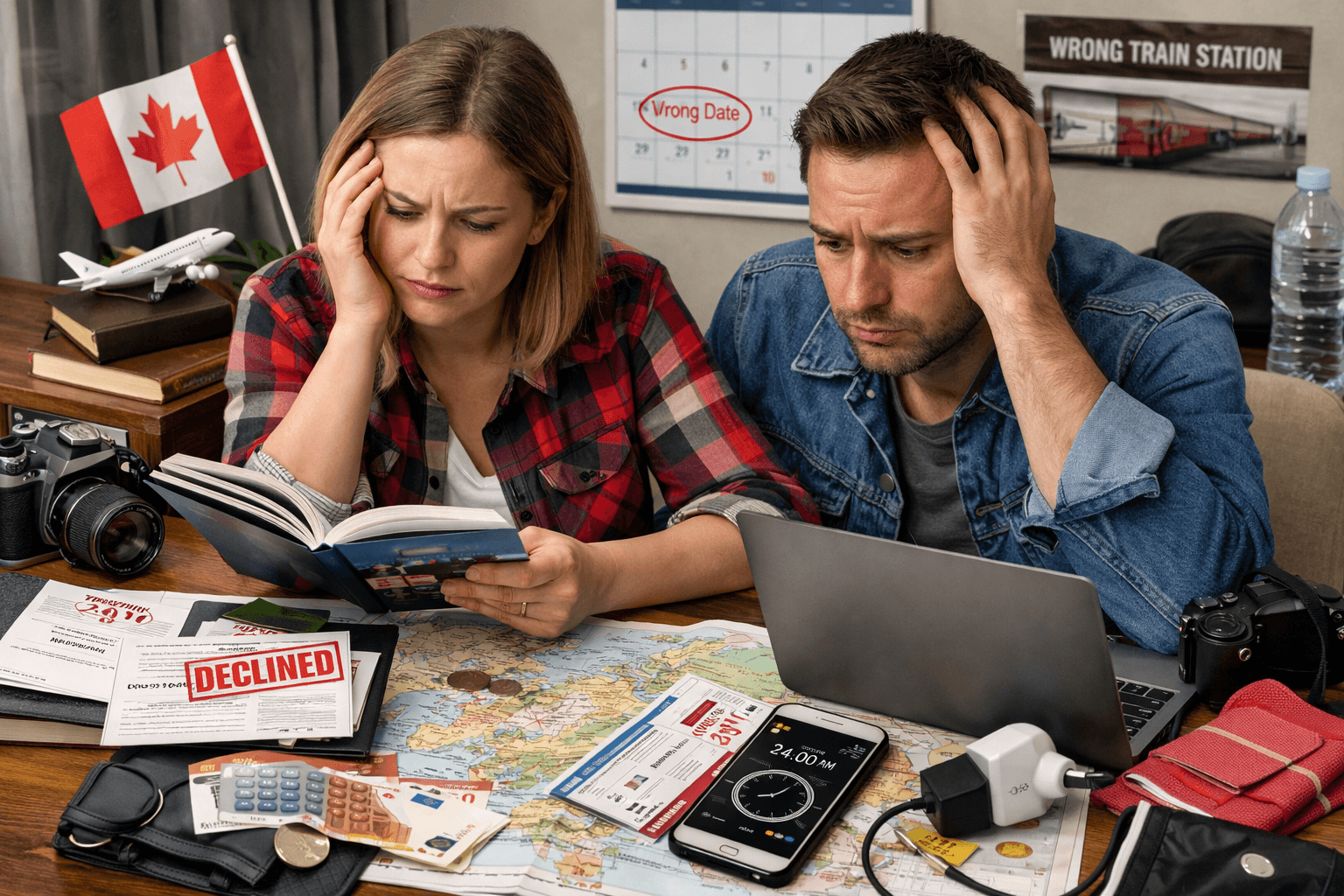
I'm based in Toronto. I plan trips for Canadians for a living. And I see the same handful of mistakes show up over and over from first-time European travelers. They cost real money, real days of vacation, and real enjoyment.
None of these are dumb. They're the kind of mistakes anyone makes when they're booking their first big international trip and going off advice from a travel blog written for Americans, or worse, written for nobody in particular and just SEO-optimized.
Here are the 10 I see most often, and the actual fix for each.
1. Booking flights months before booking anything else
The mistake: You see a flight deal. Toronto to Rome, $750 round-trip, and you grab it. Then a month later, you start planning the actual trip and realize your dates don't line up with anything you wanted to do.
The fix: Even a rough plan beats no plan. Before you book the flight, sketch a 2-line itinerary: "Land in Rome, train to Florence on day 4, fly home from Venice on day 9." Now your flight search has constraints (multi-city Toronto-Rome / Venice-Toronto), and you'll save real money on the back end by not having to backtrack to your arrival city.
2. Picking the wrong arrival city
The mistake: Most Canadians fly into Paris, London, or Rome because those are the famous ones. Then they spend two days on jetlag in the most expensive city of their trip.
The fix: Fly into the least exciting city on your itinerary, and save the famous one for the end when you're acclimated. If you're doing Italy, fly into Milan or Bologna and end in Rome. If you're doing France, fly into Lyon or Marseille and end in Paris. You'll save money on hotels in the first 2-3 days, and you'll experience the famous city when you actually have energy for it.
3. Forgetting that "1 hour difference" between cities is not 1 hour of travel
The mistake: Google says "Florence to Cinque Terre: 2 hours" so you build a day trip around it. In reality, with the train transfer in La Spezia, the walk to the platform, the wait time, and the 5-village village-hopping logistics, you're looking at 4-5 hours of round-trip travel for maybe 3 hours of actual sightseeing.
The fix: Always add 50% to Google Maps estimates for European train and bus journeys. Always assume the first and last day in any city are half-days at best. Don't book three things in a single day if the third one is in a different city. Pick two things and do them well.
4. Booking the cheapest hotel "in the center"
The mistake: "Centro storico" or "city centre" or "1st arrondissement" all sound like the right answer. They're not always. The "center" in many European cities is dominated by tourist traffic, overpriced restaurants, and noise that ruins your sleep.
The fix: Look one neighborhood over. In Florence, stay in Oltrarno instead of around the Duomo. In Rome, stay in Monti or Trastevere instead of next to the Trevi Fountain. In Paris, stay in the 11th instead of the 1st. You'll pay 30-40% less, sleep better, eat at restaurants where locals actually go, and walk to the famous spots in 15 minutes.
5. Not factoring in the Schengen 90-day rule
The mistake: You're planning a 6-month sabbatical or a long mixed Europe + UK trip and didn't realize that as a Canadian, you can only spend 90 days in any 180-day period inside the Schengen Area without a visa.
The fix: This rule trips up Canadians constantly. The Schengen Area covers most of Western Europe but NOT the UK or Ireland. If your trip is over 90 days total, you need to plan non-Schengen breaks (London, Edinburgh, Dublin, Croatia, Romania, etc.) or apply for a long-stay visa from one of the Schengen countries. Don't ignore this. Overstaying can get you banned from re-entry for years.
6. Skipping travel insurance because "I have credit card coverage"
The mistake: Your credit card "includes" travel insurance, so you skip buying real insurance. Then something goes wrong and you discover the credit card coverage has a $1,500 cap on medical, requires you to charge the entire trip on that specific card, and excludes pre-existing conditions you forgot you had.
The fix: Read your credit card insurance certificate. Actually read it. If you're going to Europe and skiing in the Alps, doing any extreme sports, or have any pre-existing medical condition, get supplemental insurance. A $50-100 trip insurance policy from a Canadian provider (Manulife, TuGo, World Nomads for adventure trips) is cheap insurance against $50,000 in medical bills that nobody wants to think about.
7. Bringing the wrong amount of cash
The mistake: Either bringing $2,000 in cash from a Canadian bank (terrible exchange rate, scary to carry) or bringing $0 and assuming "everywhere takes credit card."
The fix: Bring $200-300 in Euros from your Canadian bank for first-day expenses (taxi, snacks, tips). Then withdraw cash from ATMs in Europe as you need it. The exchange rate is dramatically better than buying Euros in Canada. Use a card with no foreign transaction fees (Wise, EQ Bank, Brim Mastercard) for everything else. Most of Europe takes cards, but smaller restaurants, taxis in some countries, and public toilets sometimes don't.
8. Not learning ANY of the local language
The mistake: "Everyone speaks English in Europe." This is partially true and completely beside the point. You don't need to be fluent. You need to learn 5-10 words in each country's language to be perceived as a respectful traveler instead of a clueless tourist.
The fix: Learn these in the local language before each country: hello, please, thank you, sorry, "do you speak English?", goodbye. That's 6 words per country. Total prep time: 20 minutes. Total impact on how locals treat you: enormous. Italians especially notice when you say "buongiorno" instead of barging in with "hi do you speak English."
9. Underestimating what jet lag does to your trip
The mistake: You arrive in Paris at 9am, drop bags at the hotel, and immediately try to "make the most of the day" by walking the city for 12 hours. Then you crash at 4pm, sleep through dinner, wake up at 2am, and ruin your sleep for the rest of the trip.
The fix: Land in Europe in the morning. Force yourself to stay awake until 8pm local time, but go EASY that first day. A walking neighborhood, a long lunch, an outdoor café, an early dinner. No museums (you won't remember them), no major attractions (save them for day 2), no driving. Sleep at 9-10pm local. You'll wake up the next day on European time and the rest of your trip will work.
10. Going in July or August because it's summer vacation
The mistake: You're a teacher, you have kids in school, or you can only take vacation in July/August. So you book Europe for the worst possible months: peak heat, peak crowds, peak prices, and locals on vacation themselves so the cities feel hollowed out.
The fix: If you have absolutely no flexibility, fine, go in summer. But at least pick the right destinations. Northern Europe (Iceland, Norway, Sweden, Scotland, Ireland) is at its absolute best in July and August: long days, mild temperatures, every outdoor activity available. Mediterranean Europe (Italy, Spain, Greece, Croatia) is at its worst: 35°C heat, no breeze, overrun with tourists, locals fled to the coast or surly with the crowds.
If your dates are fixed, change your destination to match. If your destination is fixed, change your dates if you possibly can.
Bonus: The thing nobody tells you
Most Europe trips fail in small ways, not big ways. You'll still have a great time even if you make 5 of these mistakes. Europe is too good to ruin entirely. But the difference between a "great trip" and a "best trip of my life" is usually 10-15 small decisions made right at the beginning, before you even pack a bag.
That's the entire reason I built Savvy Jetsetter. Most trip planners are written for hypothetical travelers in hypothetical situations. I wanted something built specifically for the actual Canadian planning their actual trip, with the right context (Schengen rules, Toronto/Vancouver flight patterns, Canadian credit card coverage, the actual weather you should expect), not generic advice copied from a US blog.
If you want a free starting point, generate a trip plan here. It takes about 60 seconds and gives you a day-by-day European itinerary. If you want a real human helping with the trickier stuff, book a free consultation and I'll walk you through it personally.
Either way, don't make these 10 mistakes. They're the most expensive part of any first European trip, and they're the easiest ones to avoid.
Bobby Atwal is the founder of Savvy Jetsetter and a certified travel advisor with Fora Travel, based in Toronto, Ontario. He plans European trips for Canadian travelers every week.